
.svg)
.svg)

Aufbau Technologies · Turbo App
Helping EV owners in Delhi drive farther without fear




Overview
Care for Caregivers Online (COCO) is a B2B startup focused on wellness solutions for caregivers via its proprietary chatbot, CocoBot.
For my grad school capstone project, I teamed up with three of my classmates to enhance how caregivers approach and practice self-wellness.
For six months from January - June 2021, we worked with the co-founders of COCO and the clinical and engineering teams. Our target audiences were non-professional caregivers caring for people with chronic conditions.
Role
Product Designer
Team
Elisabeth Dunn
Teresa Cummings
Miaoxin Wang
Organization
University of Washington Human-Centered Design & Engineering
(In partnership with COCO)
Timeline
January 2021 - June 2021
Overview and Project Highlights
- SLP Demo (demo.summitlearning.org) was an important tool for educating both new and existing SLP users on the functionalities of SLP. Driven by concerns over high maintenance costs, complexity, and usability issues, the leadership decided to cease operation of SLP Demo.
- I led the transition from the high-maintenance SLP Demo to a streamlined Figma-based alternative. I initiated the strategy, conducted user research, and executed the design end-to-end, significantly reducing complexity and operational costs.
Organization
Chan Zuckerberg Initiative
(in partnership with Gradient Learning)
Product
Timeline
Jan 2023 - June 2023
Role
Lead Designer
Team
Product Specialist (Project co-lead)
Content Strategist (contributor)
Support Specialist (contributor)
Product manager (inform)

Overview
Boundless Immigration needed to improve profit margins while scaling. I identified a critical bottleneck where attorneys were spending nearly 20% of their day on administrative tasks because the company lacked a traditional paralegal layer.
I led the research to diagnose this efficiency gap and pitched the findings directly to the COO and VP leadership. My recommendations resulted in a strategic pivot and the launch of a new business line.
Role
Lead UX and Service Designer
Team
Product Manager
VP of Product
Engineering Lead
Ops Stakeholders
(Presented to C-Suite & VP Leadership)
Organization
Boundless Immigration
Timeline
Aug - Dec 2025
Overview
New teachers and school leaders of Summit Learning Program were struggling to navigate training resources.
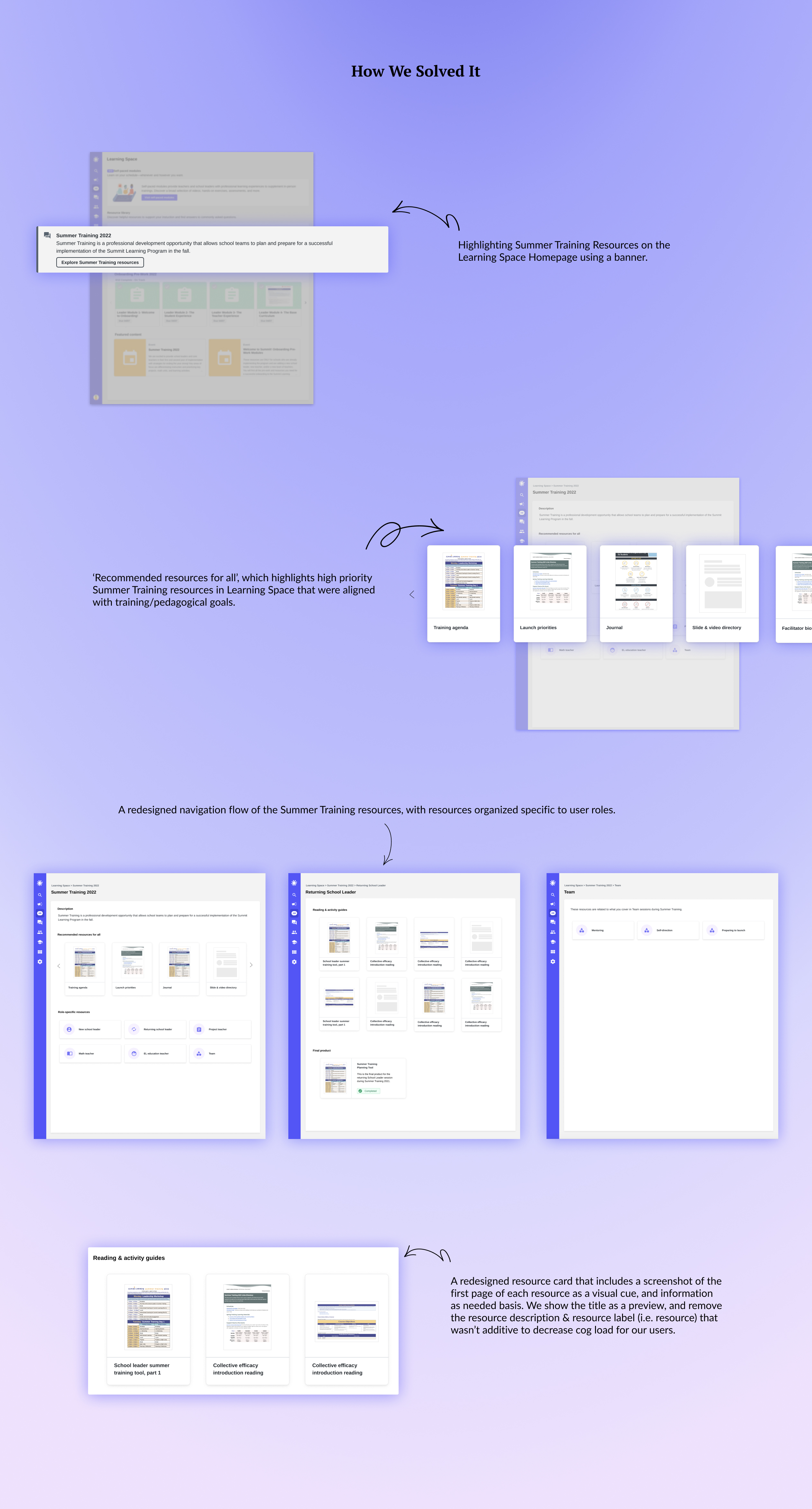
I teamed up with the content strategist to redesign the Information Architecture of Learning Space, a content repository on SLP.
This redesign resulted in reduced support tickets for the O&T team and enhanced user experience for educators during Summer Training 2022.
Role
Lead Designer
Team
Content Strategist
Product Specialist
2 Software developers
Product manager
Data Scientist
Organization
Chan Zuckerberg Initiative
(in partnership with Gradient Learning)
Product
Timeline
Jan - June 2022
Overview
EV drivers of Delhi go through range anxiety, which leads to slower adoption of electric vehicles.
As the founding designer of Aufbau Technologies, I worked on the charger app called 'Turbo', and the marketing website, defining the UX strategy, performing user research, and establishing a cohesive visual language for the entire organization.
Role
Founding Designer
Team
Cofounder
CTO
Organization
Aufbau Technologies
Timeline
September 2018 - March 2019
Overview
Along is the teacher-student connection builder designed for educators to build meaningful 1:1 connections with their students.
I worked on a tool that lets teachers build deeper, more meaningful connections with students to enhance classroom engagement.
The tool resulted in a 10% increase in teacher engagement, and fostered a culture of student wellbeing and engagement.
Role
Lead Designer
Team
Brand Designer
UX Researcher
Product Manager
Software Developers
Product Specialist
Data Scientists
Content Designer
Content Strategist
The air quality in Delhi, is the worst of any major city in the world. And almost 41% of the air pollution can be attributed to vehicular emissions. Electric Vehicles have a huge potential to promote emission-free mobility in India.

But India lacks charging infrastructure to make this shift to an all-electric mobility. Aufbau Technologies was a startup working to solve this problem of lack of charging infrastructure by developing deeply integrated hardware and software solutions for safe, seamless and simple charging experience for Indians.
The Problem
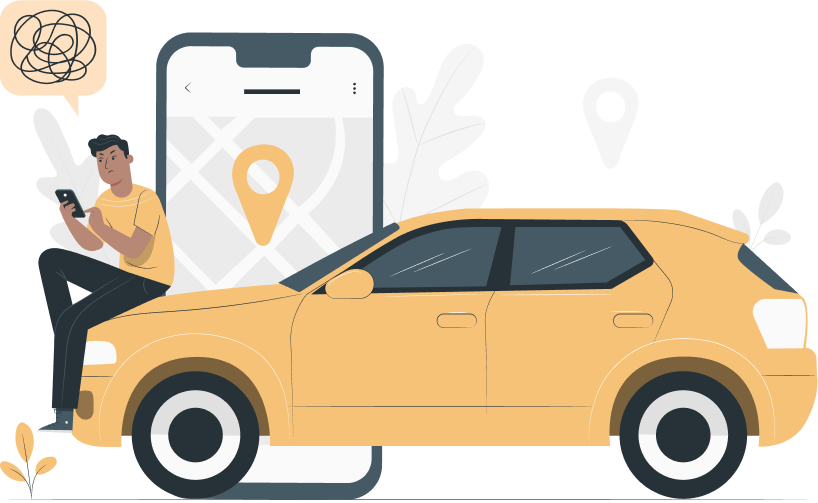
Electric Vehicle owners were unable to break out of their range anxiety and cover long distances using their EVs. This prevented faster adoption of EVs in India.

Project Goal and Hypothesis
Goal: Design an app to help users of Aufbau Technologies navigate to charging stations in India and charge their EVs through the mobile interface.
Hypothesis: Using the Turbo App, EV owners will be able to confidently take their EVs to cover long distances.
Success Metric: Decrease in range anxiety of Aufbau Tech users. At least 40% of Turbo App users cover distances longer than 200km per week.
1
Understanding the Challenge
To understand the challenge, I started having conversations with the founder and engineer, and reading the investor presentations to familiarize myself with the business goals and the world of electric vehicles.
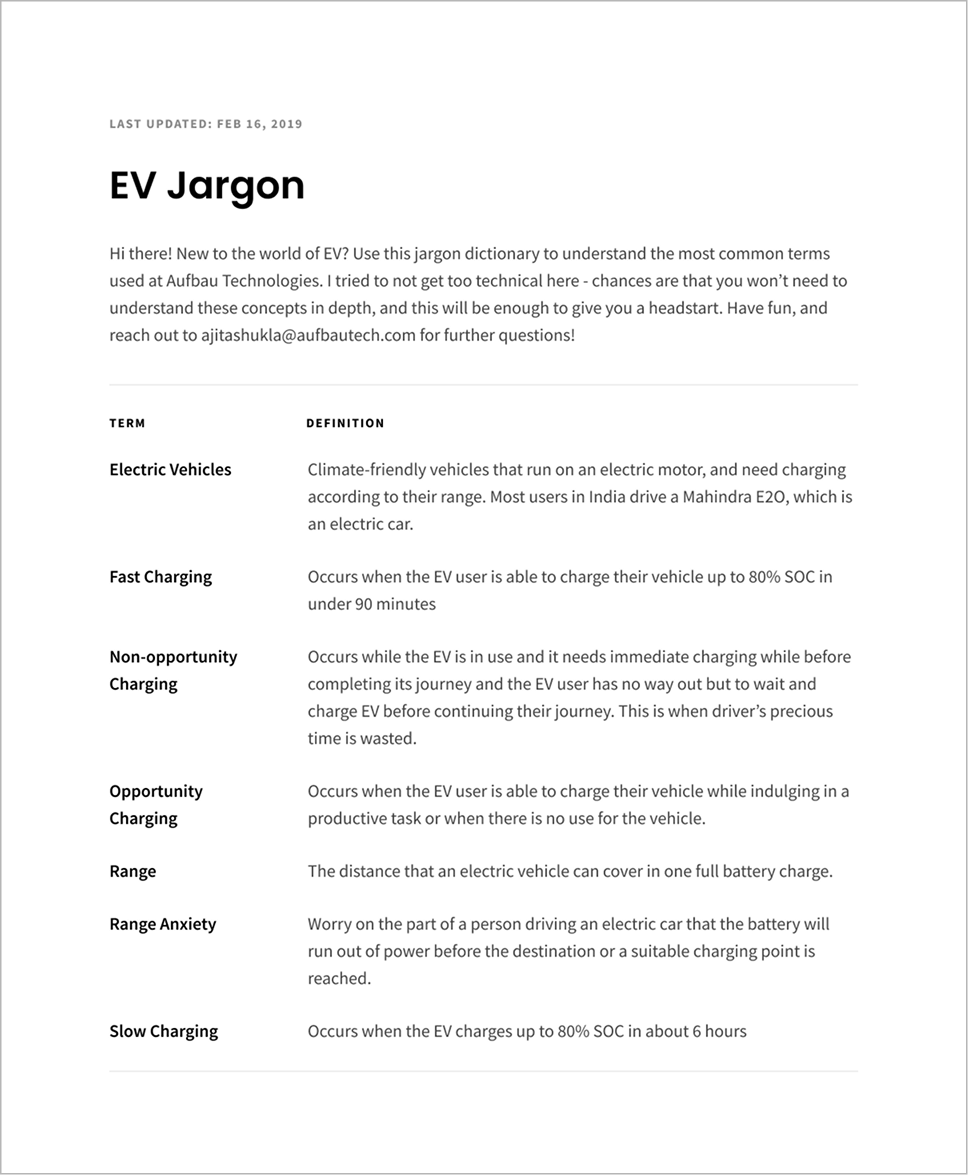
I defined an EV Jargon Dictionary for myself and the future employees of Aufbau Technologies. This proved to be a crucial artifact used for onboarding the next few employees.
Digging deep into the EV world helped me define the problem statement to align with the business goal:
How might we help EV owners find and charge their vehicles so they can save time, cost and money while charging?
We want EV owners to break out of their range anxiety by using our chargers installed at optimal locations.
We want to incentivize business owners to install chargers at their location resulting in an increased footfall for their business.

2
Understanding EV Owners
The next three weeks consisted of me conducting user research via qualitative interviews, surveys and competitive analysis, and taking the team along in the journey.
The questions we wanted answers to were:
How often do EV owners use their vehicles?
What are their current challenges while charging their EVs?
What does their day typically look like?
What do they do while charging their EVs?
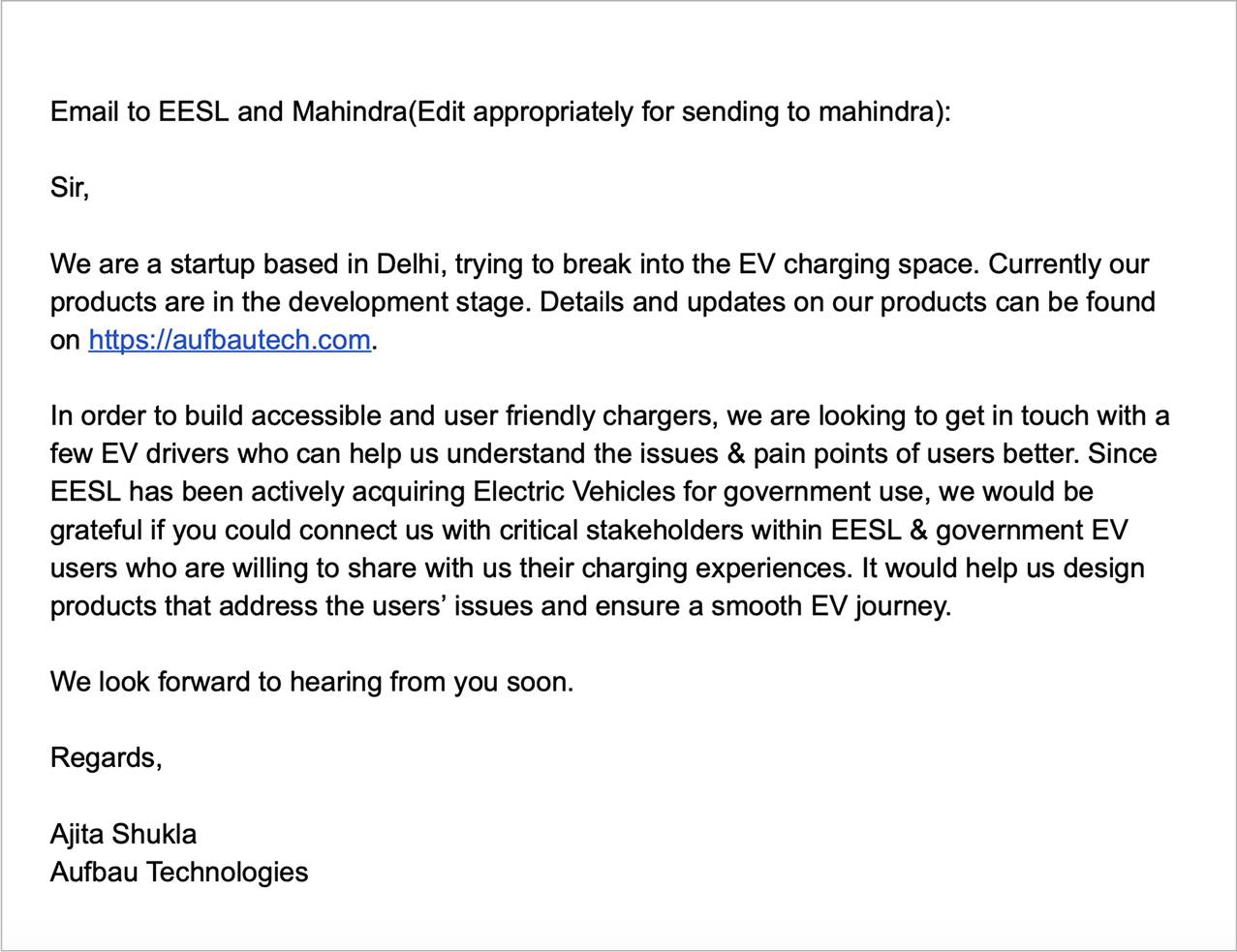
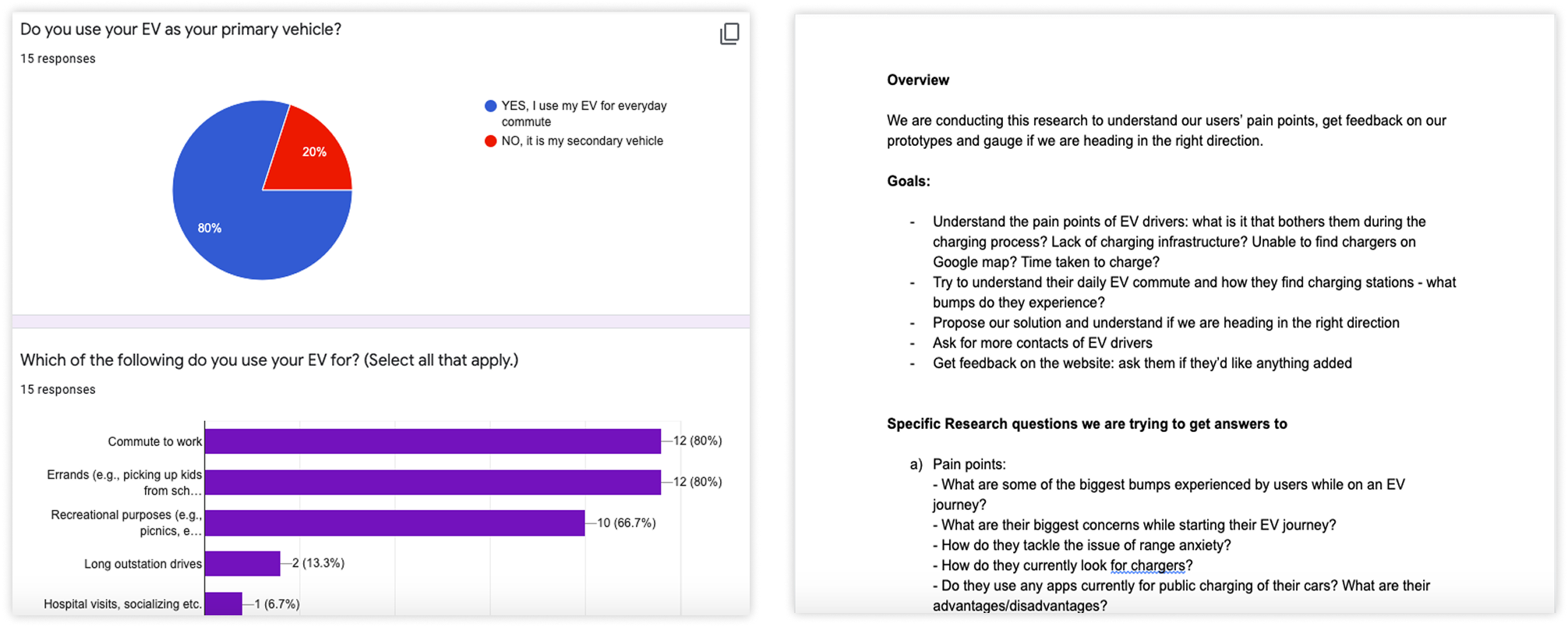
A snapshot of the research material used for surveys and qualitative interviews.
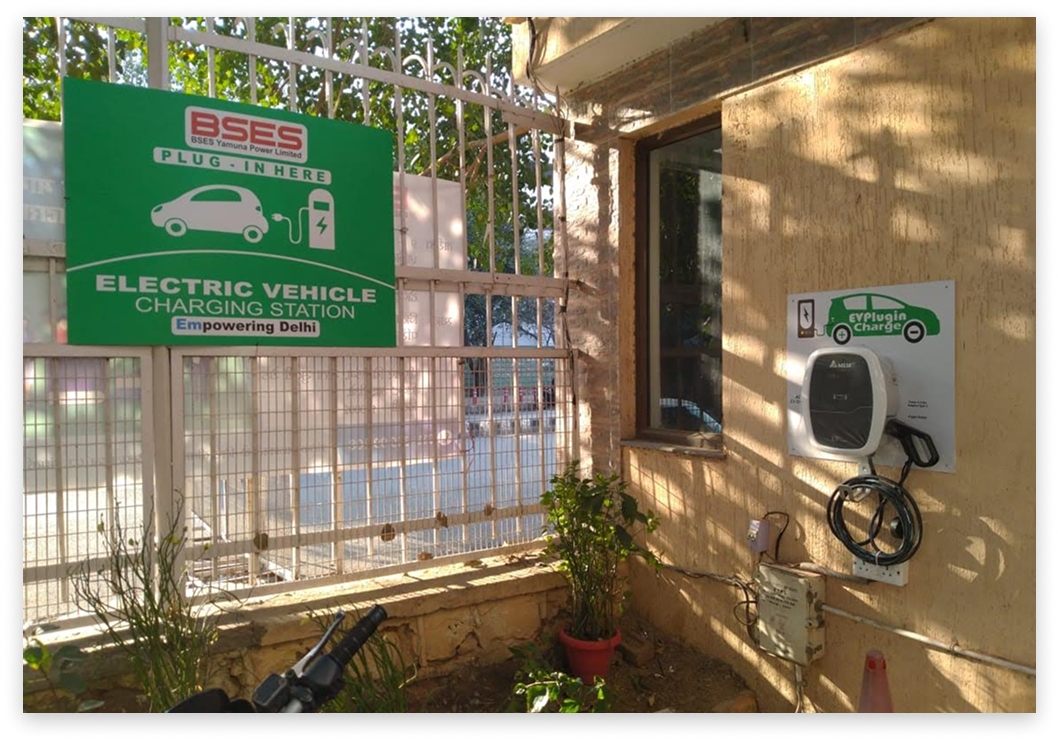
Interviewing 7 EV owners in Delhi in-person resulted in ‘field days’, wherein team members accompanied me for user interviews to take notes, ask questions, or simply observe.
During one such day, we talked to an EV owner who had installed a charger at his place (on the right). He was one of the first few people in India to have done this.
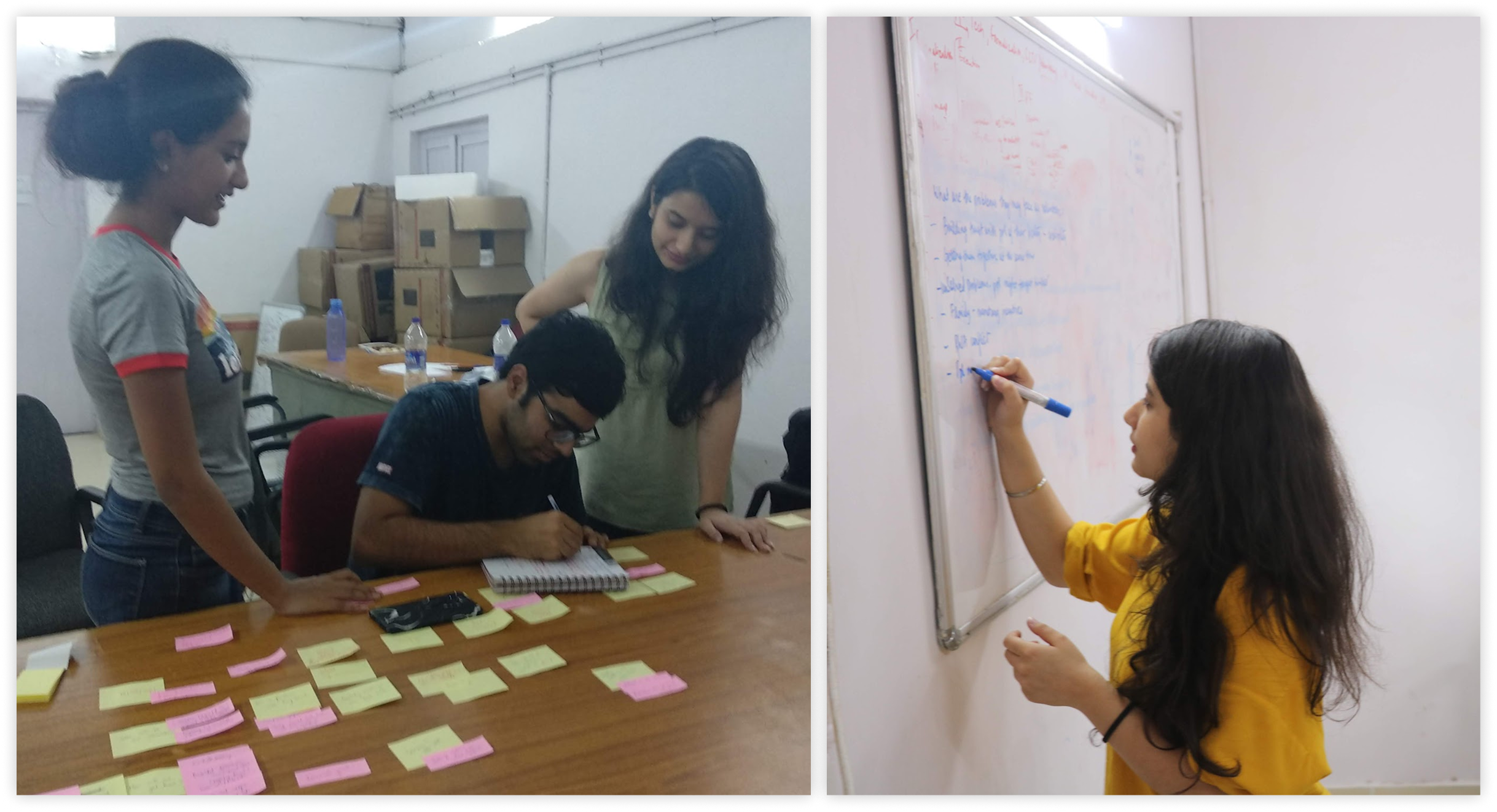
To synthesize the research insights, I held a series of workshops with the team. This really solidified the importance of user research, making the team realized how important user insights were to shape the experience of the mobile app.
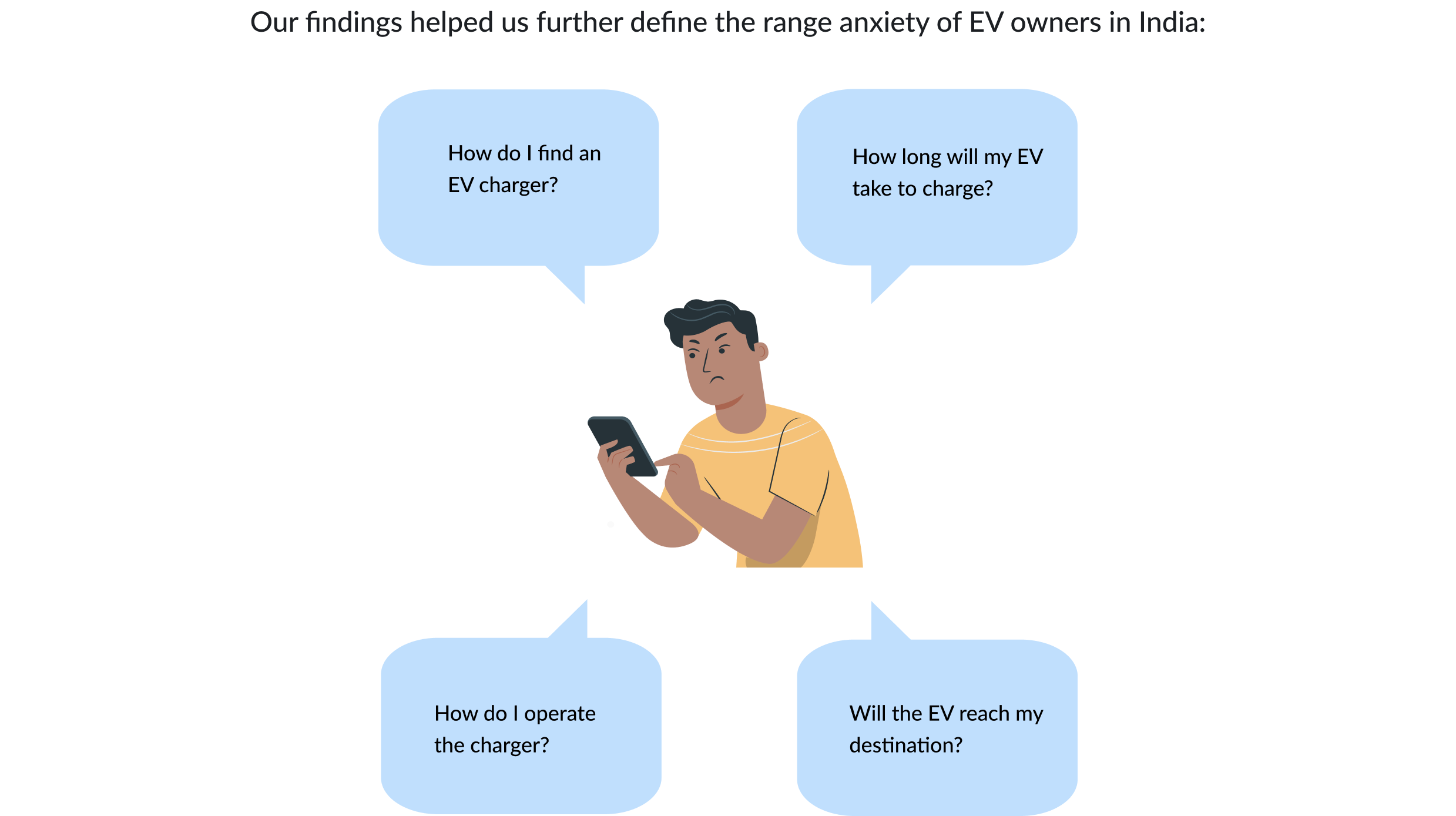
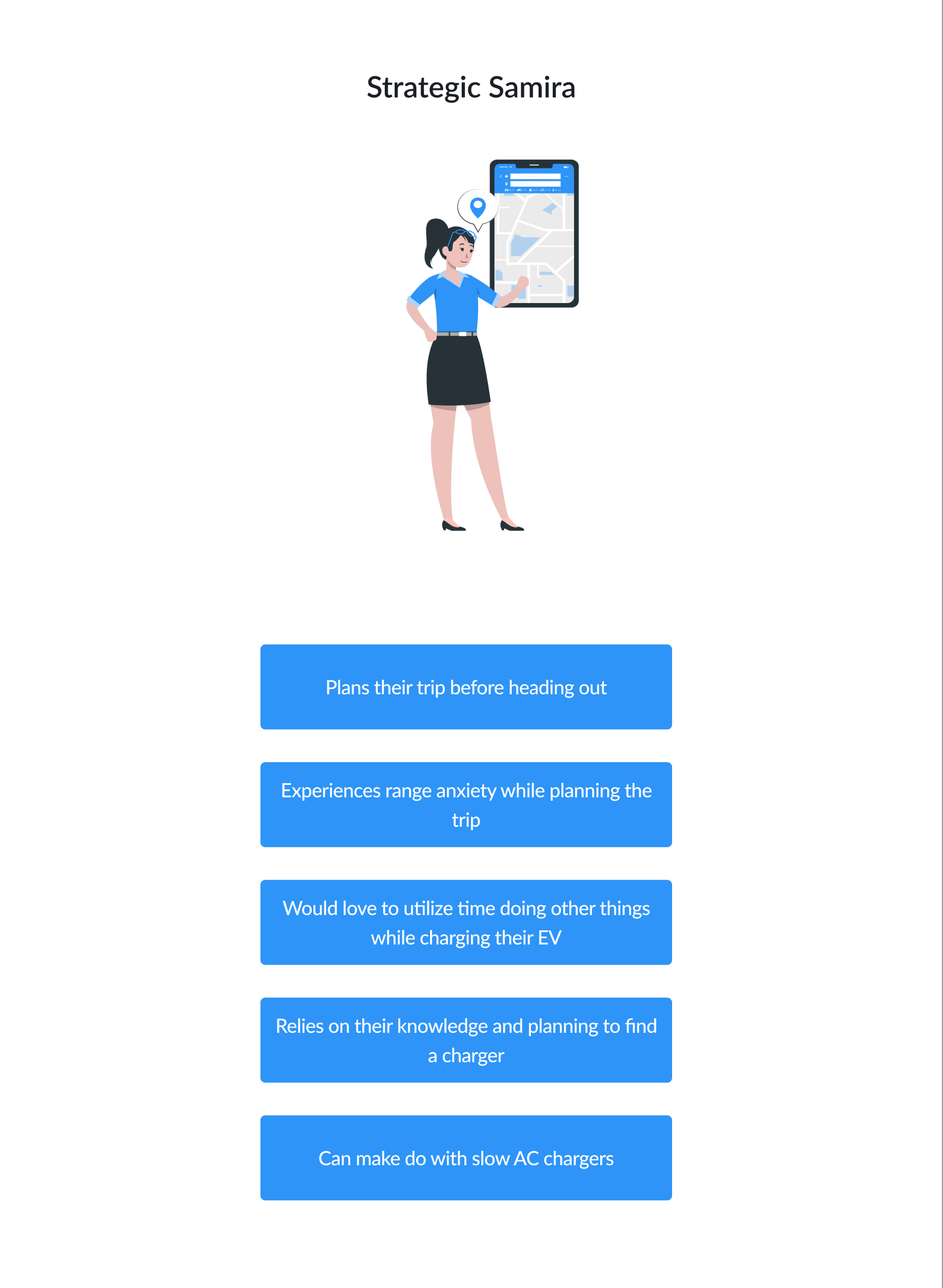
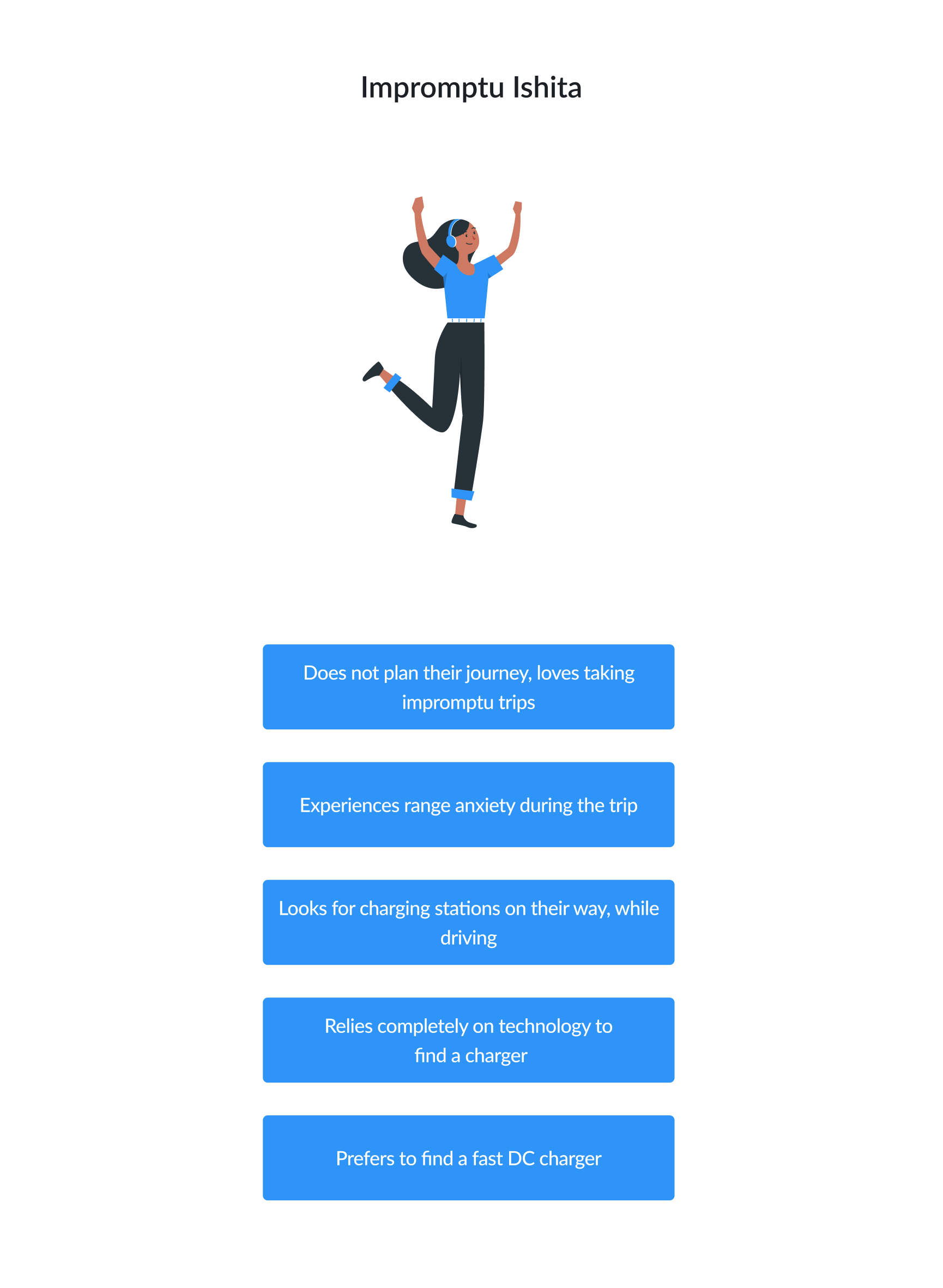
Through my research, I found two types of EV owners that experience range anxiety at different times:
3
Generating Concepts
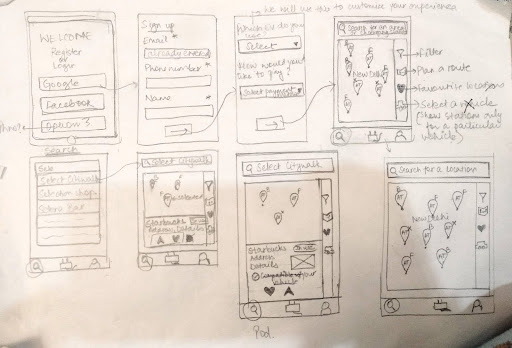
The Minimum Viable Product needed to:
⚬ save charging time for both Strategic Samira and Impromptu Ishita
⚬ walk users through the charging process
⚬ help Strategic Samira with logistical tasks related to planning their journey
⚬ help Impromptu Ishita find DC fast chargers
The MVP went through 2 rounds of usability testing before we finalized it.
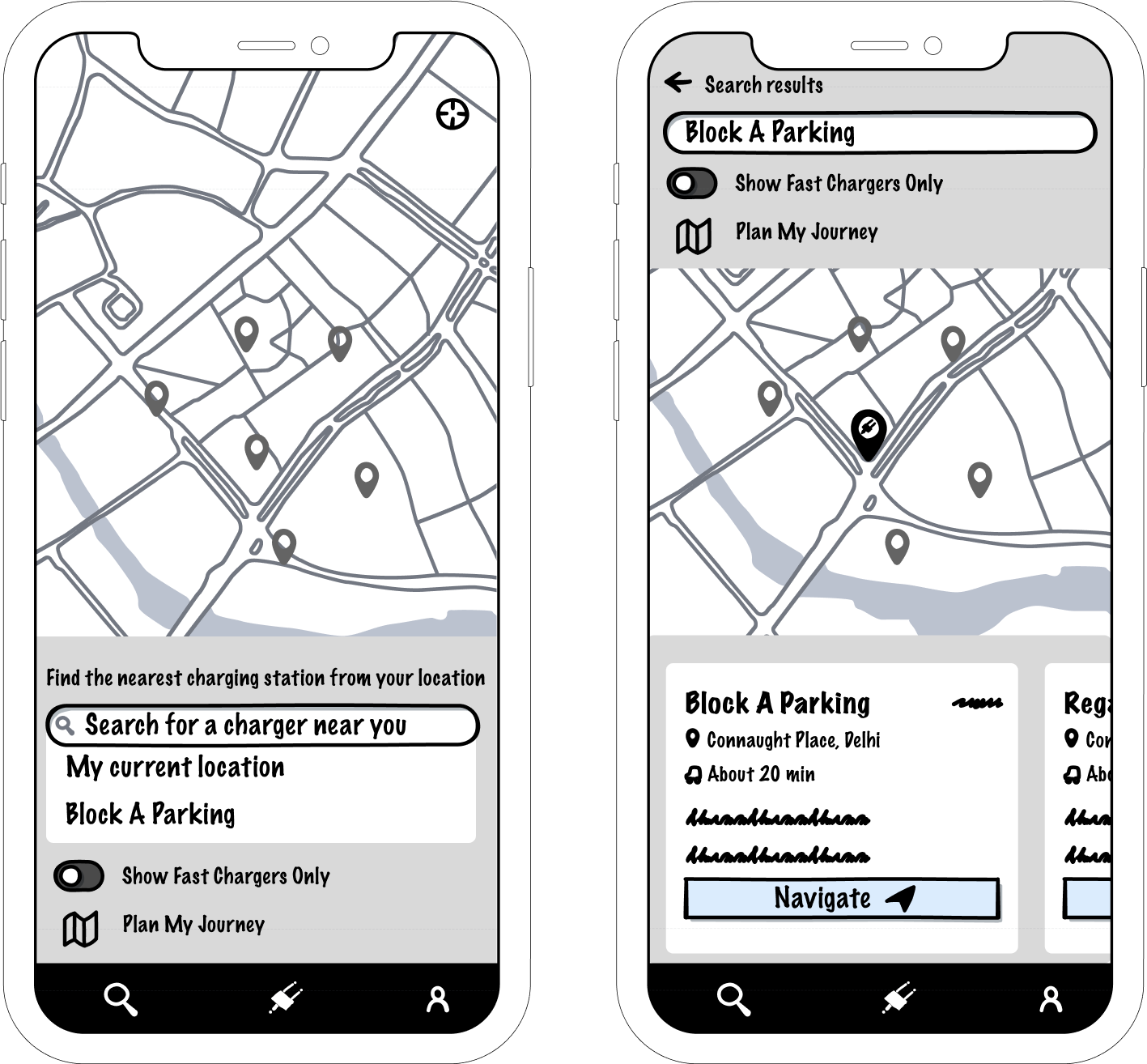
Finding the nearest charging stations for Impromptu Ishita.
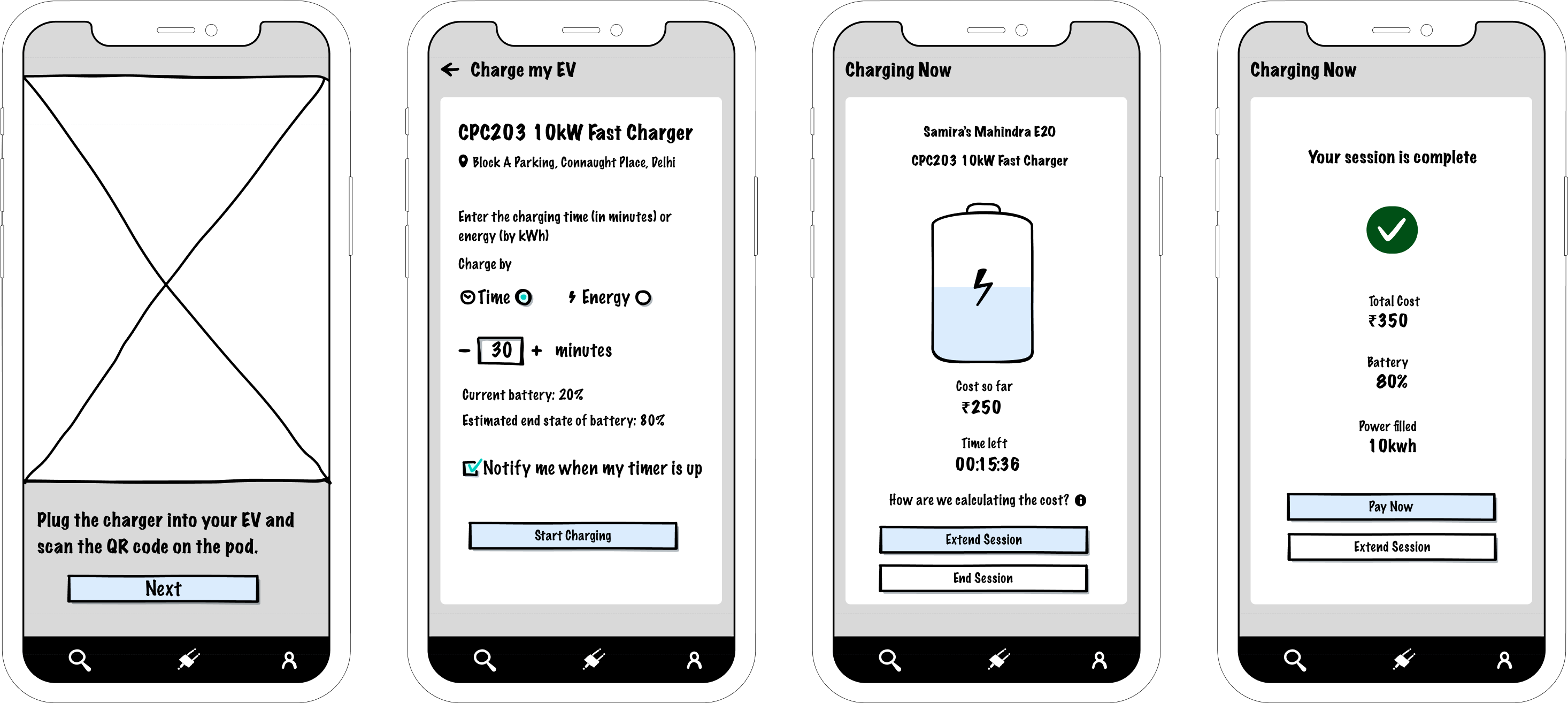
Mobile Interface to operate the charger
"Chargers are often not functional. Where can I see information regarding that?"
"What happens if I overcharge the battery and forget to plug out?"
"Often, parking spots are unsafe or unreliable. Is there a way to display information regarding that?"
"I would love to know how many chargers are available and functional along with their cost."
"Maybe we could have an option of booking chargers ahead of time?"
4
Establishing A Cohesive Visual Language
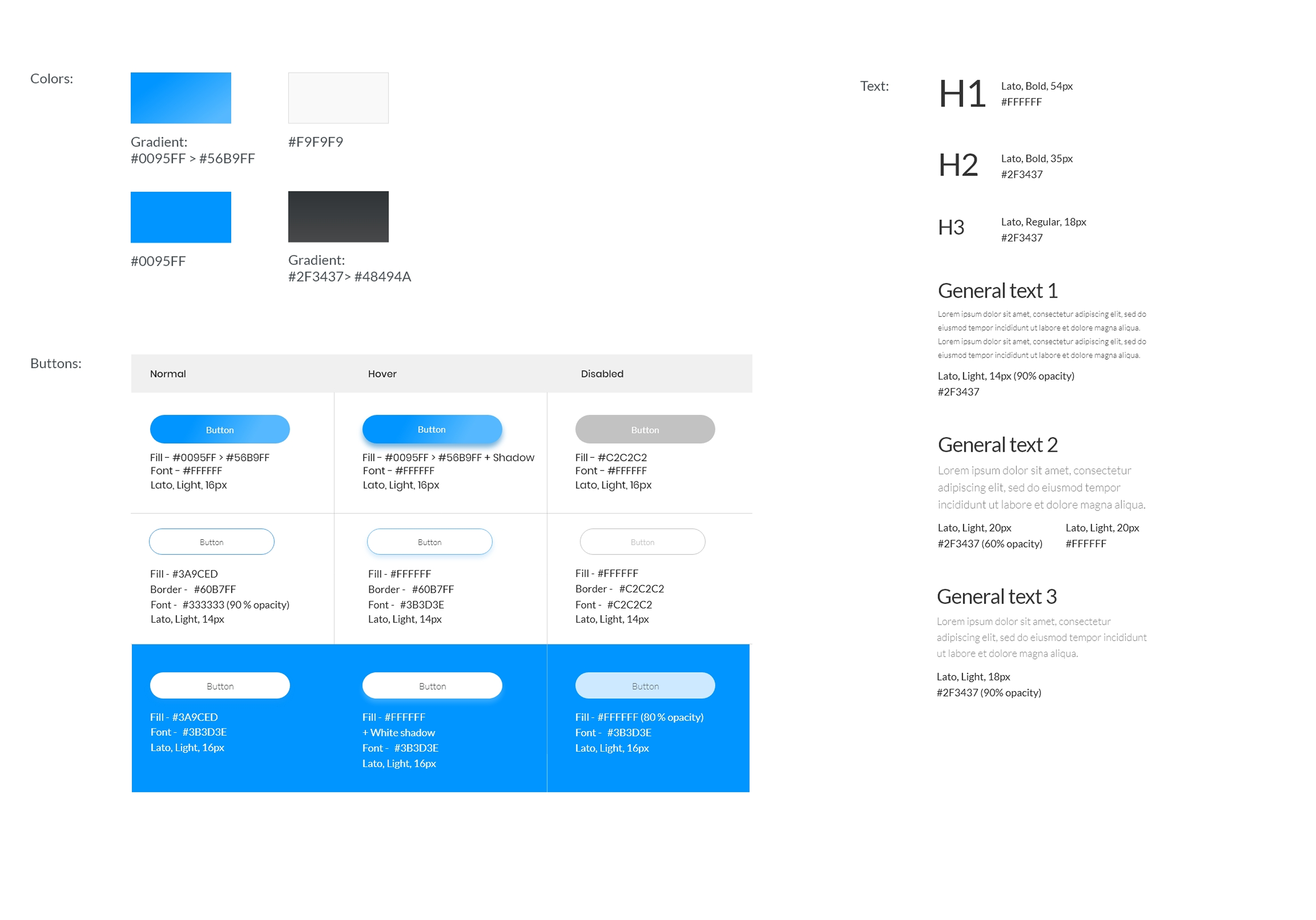
Before jumping to the final handoff for the MVP, I needed to define a cohesive visual language for Aufbau Technologies that would establish consistency across web, mobile and physical products.
I held a brand workshop where I roped in the team to engage them in the process and take their feedback to define the visual components.
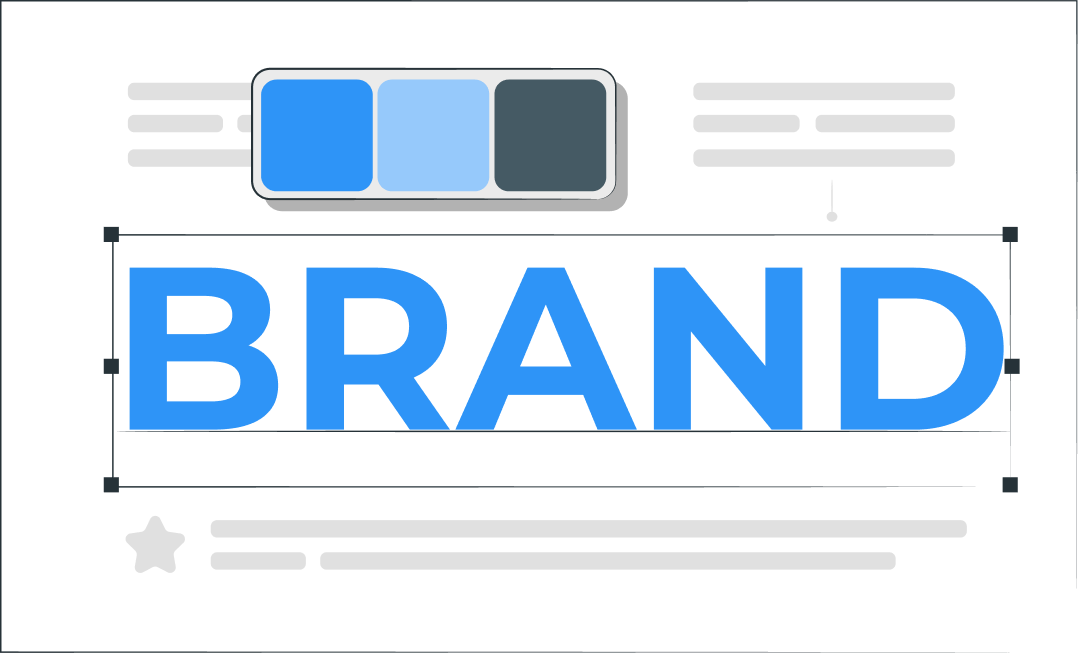

Core values and identity of the brand

Emotions we are trying to invoke in our users
FINAL SOLUTION
1) Onboarding Flow
Onboarding Flow was personalized to give customers the best experience for their vehicle.

2) Find A Charger
The MVP for finding a charger solved the needs of both strategic and impromptu users by introducing features that solved their range anxieties at different points in their journey.


3) Charge My EV
For the MVP, our aim for this feature was to introduce charging through the mobile interface. It was important to include use cases when the charger would not work.


MVP RELEASE AND IMPACT
The MVP for Turbo App was released in July 2020 when the first round of chargers were installed in Delhi, more than a year after I left the organization.
Before I left, I designed a survey to measure its impact that would help the company get quantitative data on the numbers. According to the survey:
- 50% of the respondents said they were able to cover distances more than 200km using their electric vehicles because of Aufbau Tech chargers and Turbo App.
- 57% survey respondents mentioned feeling confident in taking their EVs out on long drives.
- 53% respondents mentioned wanting to use more features on Turbo App.
CHALLENGES AND LEARNINGS
Being the founding designer of a startup at such an early stage of my career was no easy feat. I had to learn a lot of things on the fly and made mistakes along the way. The biggest challenges I faced on this project were:
- Finding EV owners willing to do usability testing with us: I had to go into the depths of the internet to find users, because we had no network of EV owners. I wore the hat of a UX researcher to send out emails and LinkedIn messages to about 50 people, finally finding 7 people.
- No established EV infrastructure in India: We were solving a tricky problem whose impact was dependent on several factors including the resources that the government was willing to invest in the infrastructure. In a lot of ways, we were contributing to a larger mission of bringing more electric vehicles on the road, which was exciting.
Reflecting on my time at Aufbau Technologies, my biggest learnings were about being a unicorn who wears many hats according to the project requirement.
- I had to be a UX leader and define a strategy for design and user experience of the startup. This made me grow a lot as a UX strategist, helping me develop tactical and strategic skills.
- I had to be a visual designer and define a brand identity, helping me develop visual design skills. At times, I also made the slide decks, pamphlets and email templates.
- I had to be a content strategist and define the tone and voice of the interface.
- I had to be a web developer to design and develop the Aufbau Tech website. This taught me essential CSS, JavaScript and Wordpress skills.
WEBSITE DESIGN FOR AUFBAU TECH
Designing a marketing website for Aufbau Technologies consisted of secondary research, defining user flow, and making wireframes.
1) User Flow for the marketing website

2) Website wireframes

3) Final Website Mockups

FINAL THOUGHTS
India is a developing country that needs its youth and government to work together to solve its challenges of overpopulation and pollution. By contributing to this project, I contributed to a larger goal of sustainability for the future generations of India.
The challenges of this project mirrored the challenges of the Indian society. I got to learn a lot about the attitudes of Indians towards sustainability and EVs. My favorite part of UX design is studying human psychology and how society is growing. This project helped me put a lot of my knowledge of the Indian society into use. Having grown up in India, this was a privilege!
Impact
- The new demo prototypes were extensively used to train ~1000 new teachers during spring and summer training 2023.
- The project managed to save the support needed from ~10 teacher support specialists every year during summer training, which amounted to 300 hours saved during the entire week.
- Ultimately, this solution saved 15 dev-week/year and 200k/year for the organization. This effort was lauded by the leadership, including the director of product and director of design.
IMPACT
- Support Ticket Reduction: Achieved a 30% drop in support tickets for finding resources, validating the direction and enabling educators to focus on teaching.
- Time Efficiency: Redesigned interface that reduced educators' resource search time by 17%, enabling them to invest more time in their core mission.
- Heartfelt Impact: Centered on educators, these positive changes resonated at the heart of the platform, celebrating the real victory in enhancing their daily routines.
REFLECTIONS
- I attended the Summer Training in New Orleans (2022), and saw the real-time implementation of the features, resulting in a significant jump in accessibility. It made me realize the impact of my work, making me proud to be working in education.
- Biggest learning: How to work with the design systems team efficiently to include their feedback early in the project.
- Biggest challenge: Working within tight engineering time and resource constraints to launch this project.
- What I would do differently: I would negotiate for more time and resources on this project, to ensure optimal experience for users.

