
.svg)
.svg)
Boundless Immigration · Legal Operations
Eliminating manual work for immigration attorneys




Overview
Care for Caregivers Online (COCO) is a B2B startup focused on wellness solutions for caregivers via its proprietary chatbot, CocoBot.
For my grad school capstone project, I teamed up with three of my classmates to enhance how caregivers approach and practice self-wellness.
For six months from January - June 2021, we worked with the co-founders of COCO and the clinical and engineering teams. Our target audiences were non-professional caregivers caring for people with chronic conditions.
Role
Product Designer
Team
Elisabeth Dunn
Teresa Cummings
Miaoxin Wang
Organization
University of Washington Human-Centered Design & Engineering
(In partnership with COCO)
Timeline
January 2021 - June 2021
Overview and Project Highlights
- SLP Demo (demo.summitlearning.org) was an important tool for educating both new and existing SLP users on the functionalities of SLP. Driven by concerns over high maintenance costs, complexity, and usability issues, the leadership decided to cease operation of SLP Demo.
- I led the transition from the high-maintenance SLP Demo to a streamlined Figma-based alternative. I initiated the strategy, conducted user research, and executed the design end-to-end, significantly reducing complexity and operational costs.
Organization
Chan Zuckerberg Initiative
(in partnership with Gradient Learning)
Product
Timeline
Jan 2023 - June 2023
Role
Lead Designer
Team
Product Specialist (Project co-lead)
Content Strategist (contributor)
Support Specialist (contributor)
Product manager (inform)

Overview
Boundless Immigration needed to improve profit margins while scaling. I identified a critical bottleneck where attorneys were spending nearly 20% of their day on administrative tasks because the company lacked a traditional paralegal layer.
I led the research to diagnose this efficiency gap and pitched the findings directly to the COO and VP leadership. My recommendations resulted in a strategic pivot and the launch of a new business line.
Role
Lead UX and Service Designer
Team
Product Manager
VP of Product
Engineering Lead
Ops Stakeholders
(Presented to C-Suite & VP Leadership)
Organization
Boundless Immigration
Timeline
Aug - Dec 2025
Overview
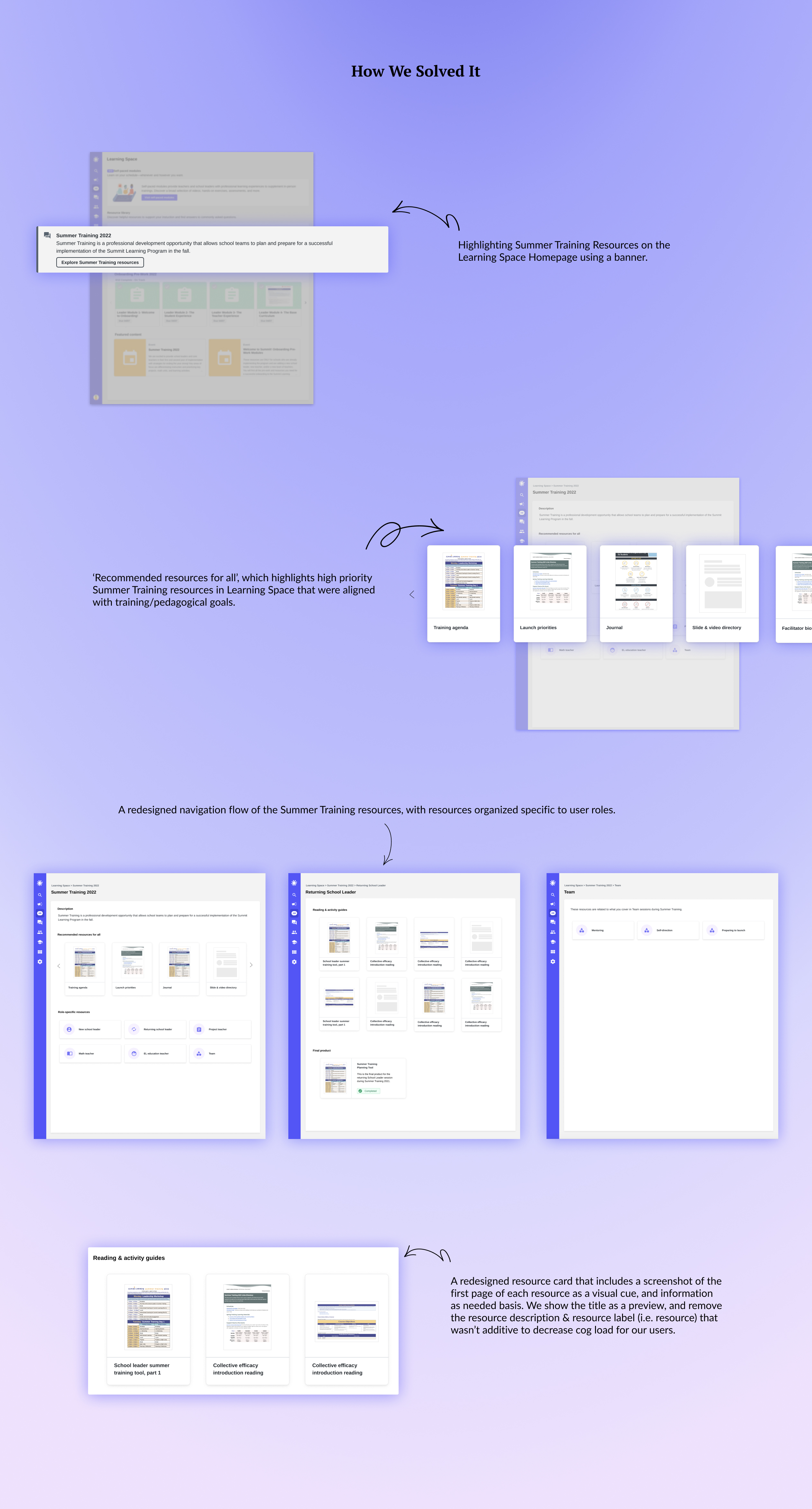
New teachers and school leaders of Summit Learning Program were struggling to navigate training resources.
I teamed up with the content strategist to redesign the Information Architecture of Learning Space, a content repository on SLP.
This redesign resulted in reduced support tickets for the O&T team and enhanced user experience for educators during Summer Training 2022.
Role
Lead Designer
Team
Content Strategist
Product Specialist
2 Software developers
Product manager
Data Scientist
Organization
Chan Zuckerberg Initiative
(in partnership with Gradient Learning)
Product
Timeline
Jan - June 2022
Overview
EV drivers of Delhi go through range anxiety, which leads to slower adoption of electric vehicles.
As the founding designer of Aufbau Technologies, I worked on the charger app called 'Turbo', and the marketing website, defining the UX strategy, performing user research, and establishing a cohesive visual language for the entire organization.
Role
Founding Designer
Team
Cofounder
CTO
Organization
Aufbau Technologies
Timeline
September 2018 - March 2019
Overview
Along is the teacher-student connection builder designed for educators to build meaningful 1:1 connections with their students.
I worked on a tool that lets teachers build deeper, more meaningful connections with students to enhance classroom engagement.
The tool resulted in a 10% increase in teacher engagement, and fostered a culture of student wellbeing and engagement.
Role
Lead Designer
Team
Brand Designer
UX Researcher
Product Manager
Software Developers
Product Specialist
Data Scientists
Content Designer
Content Strategist
Boundless simplifies the incredibly complex immigration process for immigrants and their families by providing software and legal solutions to streamline their journey. It has an ever-growing legal and operations team of attorneys, case specialists, and legal writers who work round the clock to ensure our customers (immigrants) get the least stressful experience, especially during the current hostility towards immigrants.
When I joined the organization, our product and ops leaders were trying to define margin-improving levers in the H2 2025 roadmap. They hypothesized that attorneys are our most expensive resource. If we could streamline and enhance their workflow through software, we could help them take on more cases, effectively scaling our business and improving profit margins.
This is where I stepped in: I kickstarted a research initiative to understand the time attorneys are spending during their workday and how they are interacting with our software. I owned this research end-to-end: from defining metrics and north stars, interviewing attorneys, synthesizing the research, to presenting to the leadership, and finalizing design concepts. I kept the PM and my manager (VP of Product) informed and took feedback from them throughout.
Problem
Attorneys are the most expensive resource at Boundless. The company had no insight into how attorneys spent their time, how they used our software, or where they felt stuck.


The Goal
Identify opportunities to automate, streamline and enhance attorney workflow to help them take on more cases as the business scales, directly improving the company's profit margins.
1
Diagnosing The Issue
I led a 3-week mixed-methods sprint to identify exactly where attorney time was going.
• Diary Studies: 6 attorneys logged their tasks and frustrations daily for a week.
• Contextual Inquiry: I shadowed an attorney for full workday to observe their workflow in real-time.
• Debrief Interviews: I conducted deep-dive sessions to quantify the impact of specific friction points.
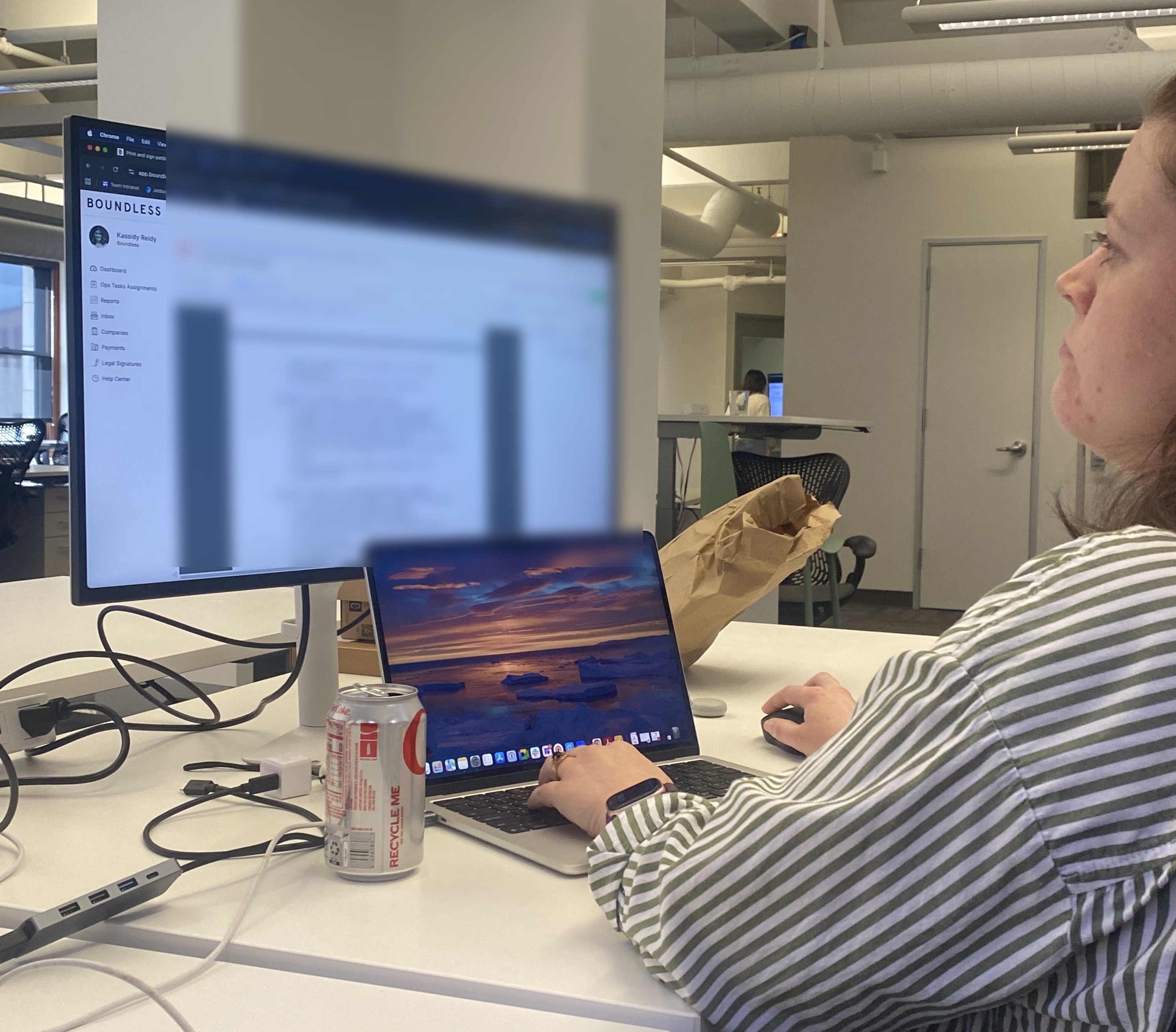
My research revealed that attorneys were spending ~20% of their day on low-value administrative tasks rather than high-value legal strategy.
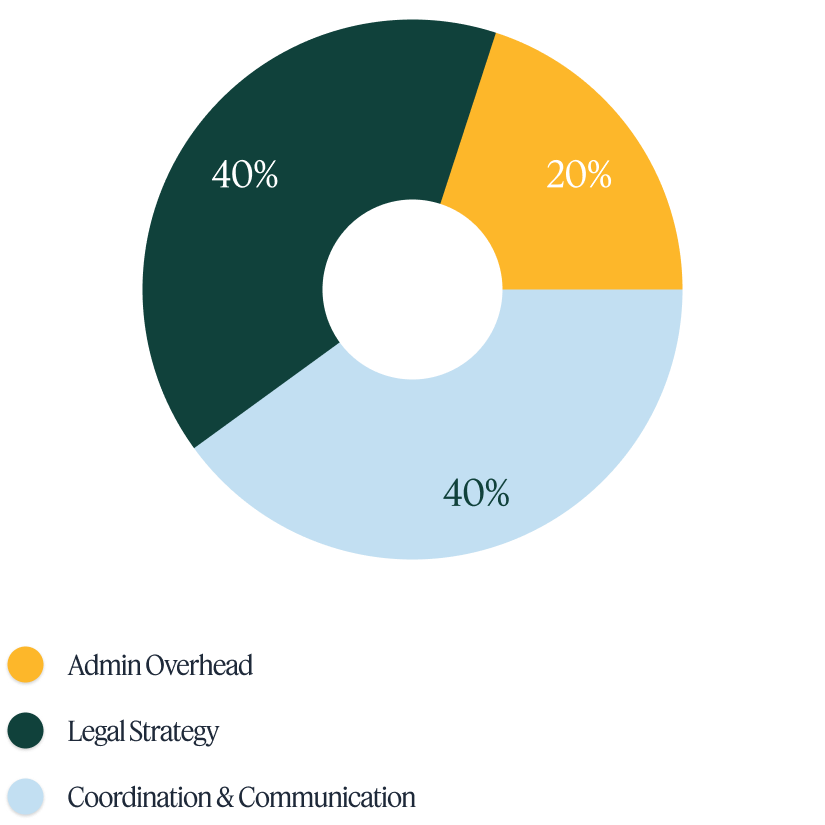
In a traditional law firm, paralegals handle document organization and quality checks. At Boundless, our software lacked that layer. We were paying legal experts to act as data entry clerks.

2
Understanding The Root Causes
The two primary drivers of this efficiency loss were hunt for context and poor input quality. These findings directly shaped our product roadmap.

3
Shifting The Focus
We started with a broad mandate: help attorneys handle more cases. However, the research revealed that capacity wasn't the root issue, waste was.
I refined our objective to focus specifically on the friction points we uncovered.

Initial Goal: Optimize Attorney Time → Focus on speed and general tools.
Refined Strategy: Eliminate System Rework → Focus on removing the specific administrative tasks (document sorting, date checking) that were blocking legal work.
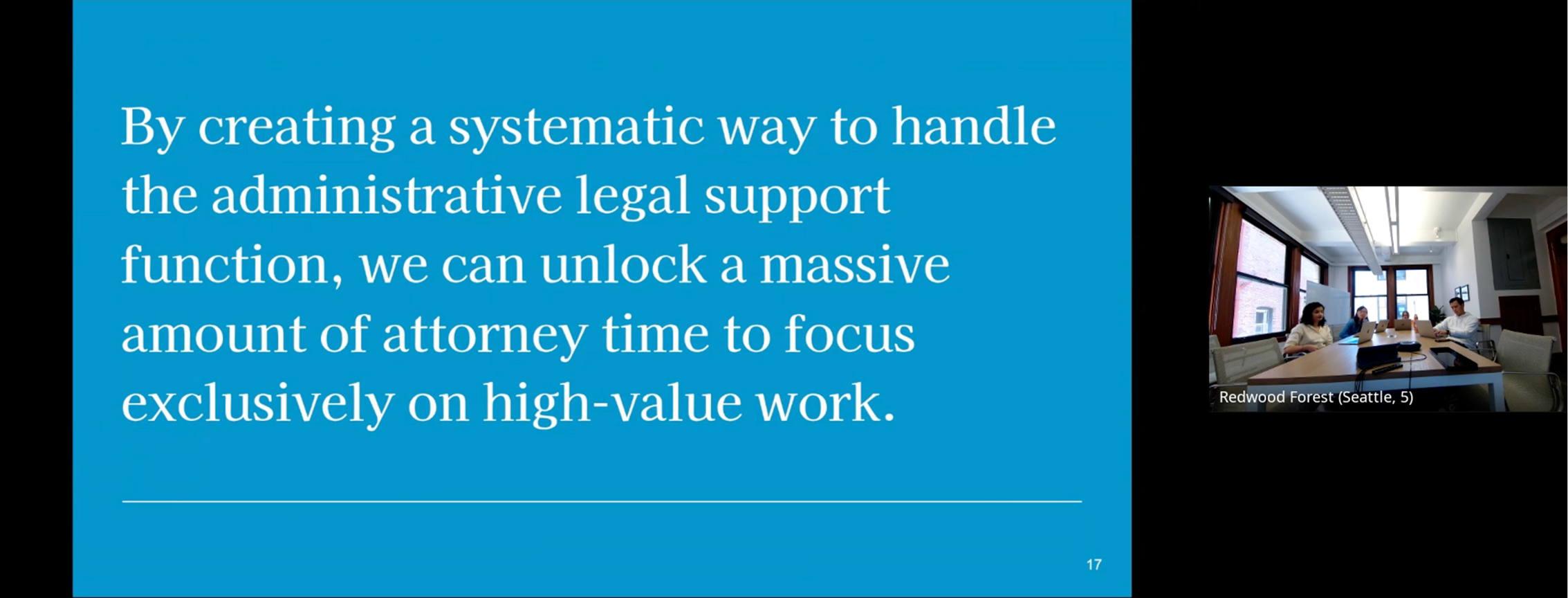
I held a research shareout meeting for VP-level executives that led to a shift in roadmap for product and operations
4
Fixing The Architecture
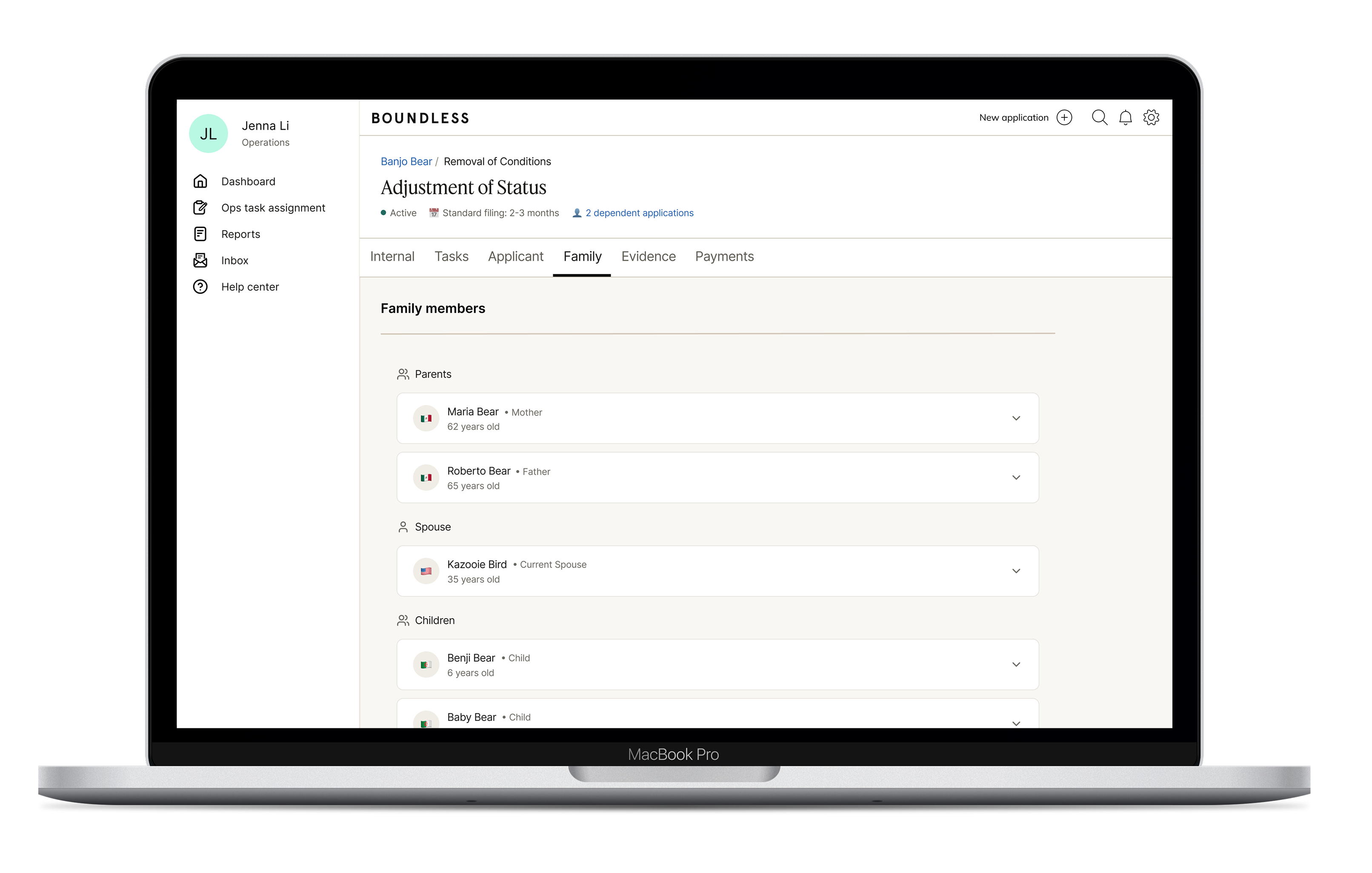
As a result of the research, fixing the family tab architecture was added to the roadmap. The Family Tab was one of the most data-dense parts of the attorney dashboard. I led user research and design iterations to create a scalable system that could handle complex family structures across multiple visa types, saving attorneys massive time on administrative work.
(On the right: old family records design)
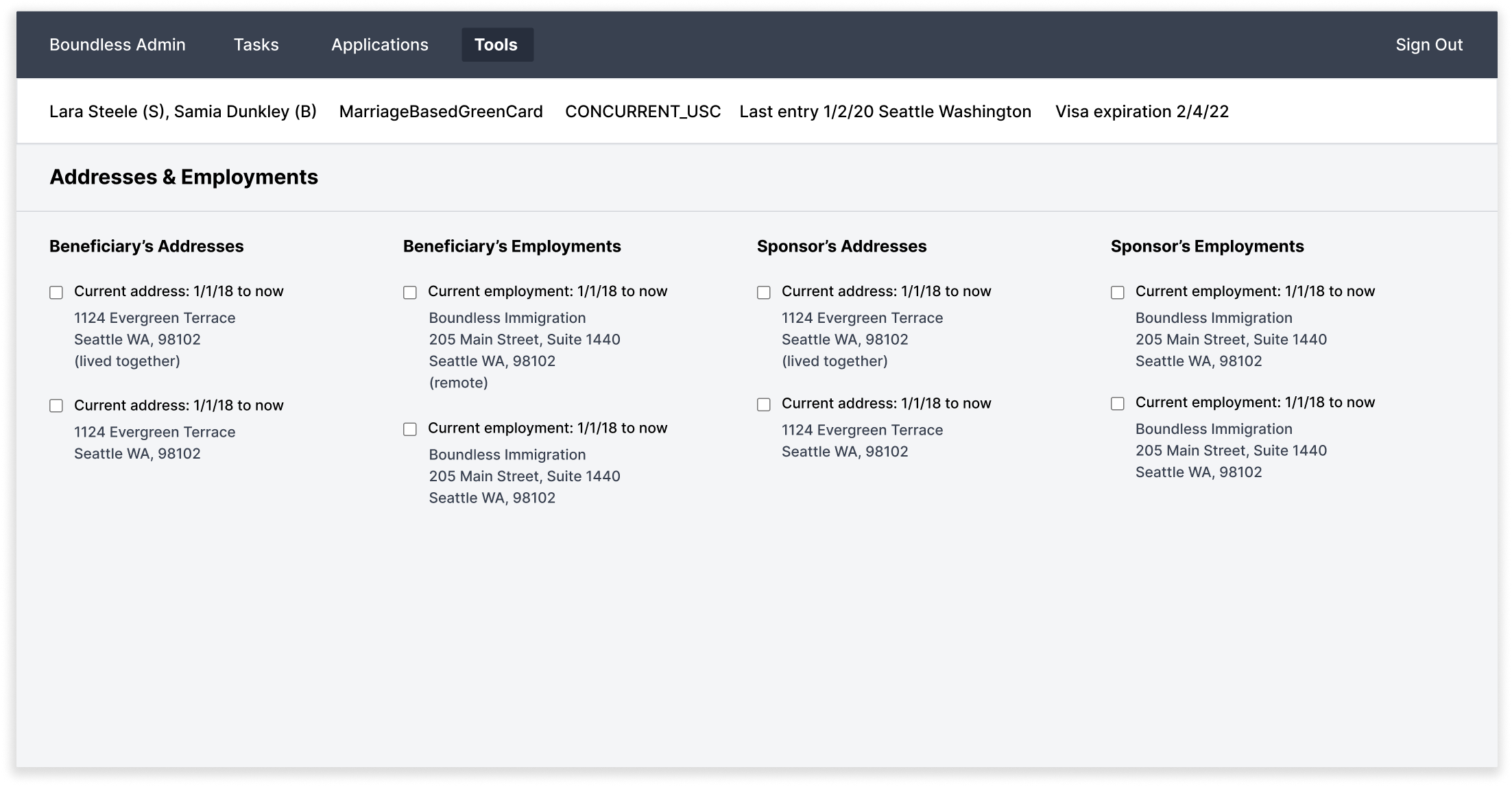
I interviewed Isabel and Jovelyn from the Operations team. They had fundamentally different needs:
"I don't always know what I'm looking for. I need to scan family structure first, then dig in." - Isabel
"I already know I'm looking for Baby Bear's birth certificate. Take me there." - Jovelyn
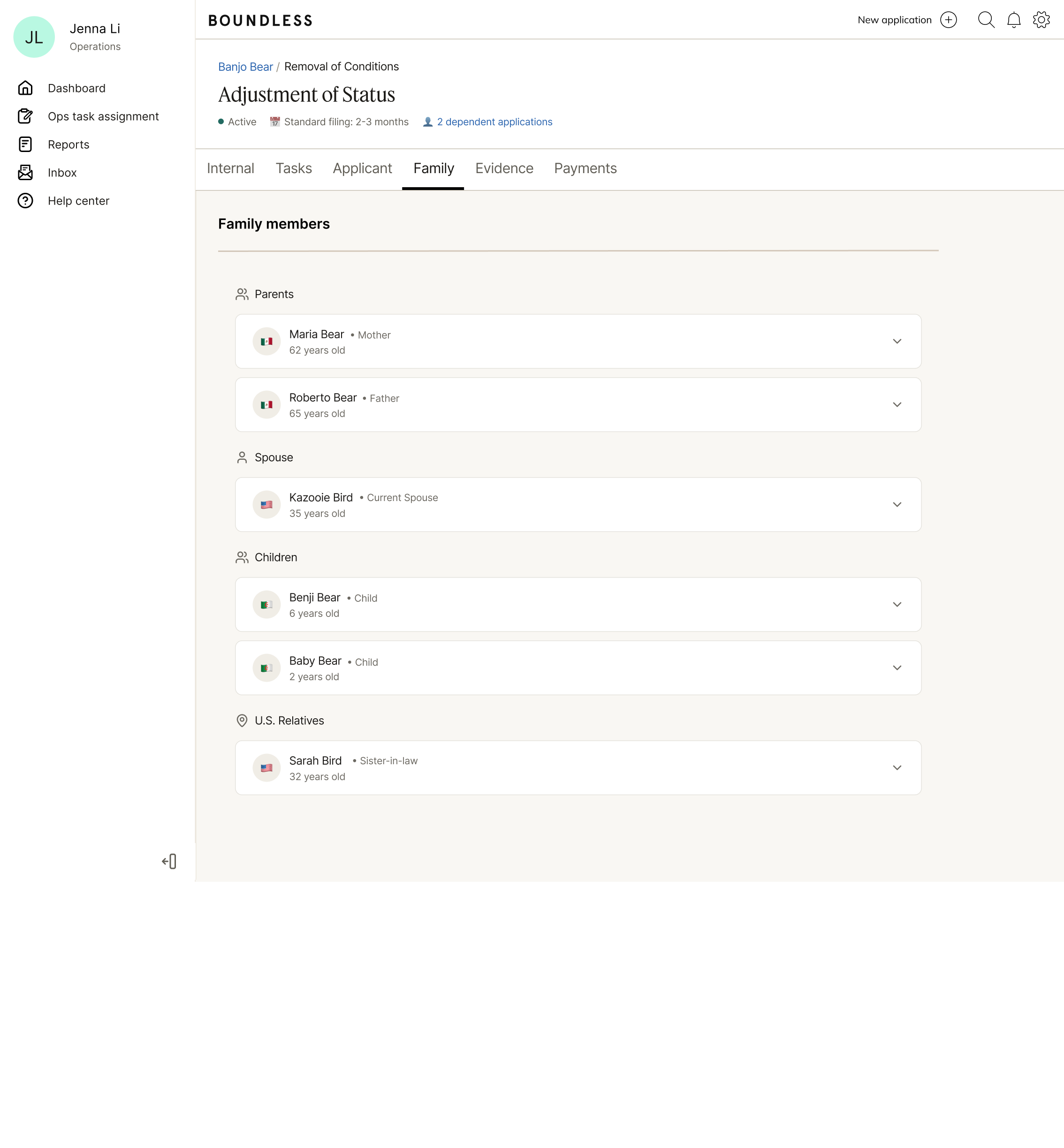
After prototyping four different concepts, user testing validated the Hybrid Hierarchy approach:
• Organized by relationship type instead of a flat list (Parents → Spouse → Children → U.S. Relatives)
• Metadata badges show marriage dates, immigration status, relationship type at a glance
• Expand/collapse at two levels: category level and individual member level
• Balanced both workflows: Isabel could scan the structure; Jovelyn could see all names grouped logically
This balanced discovery mode (scanning family structure) with task-driven workflows (finding specific family members quickly).
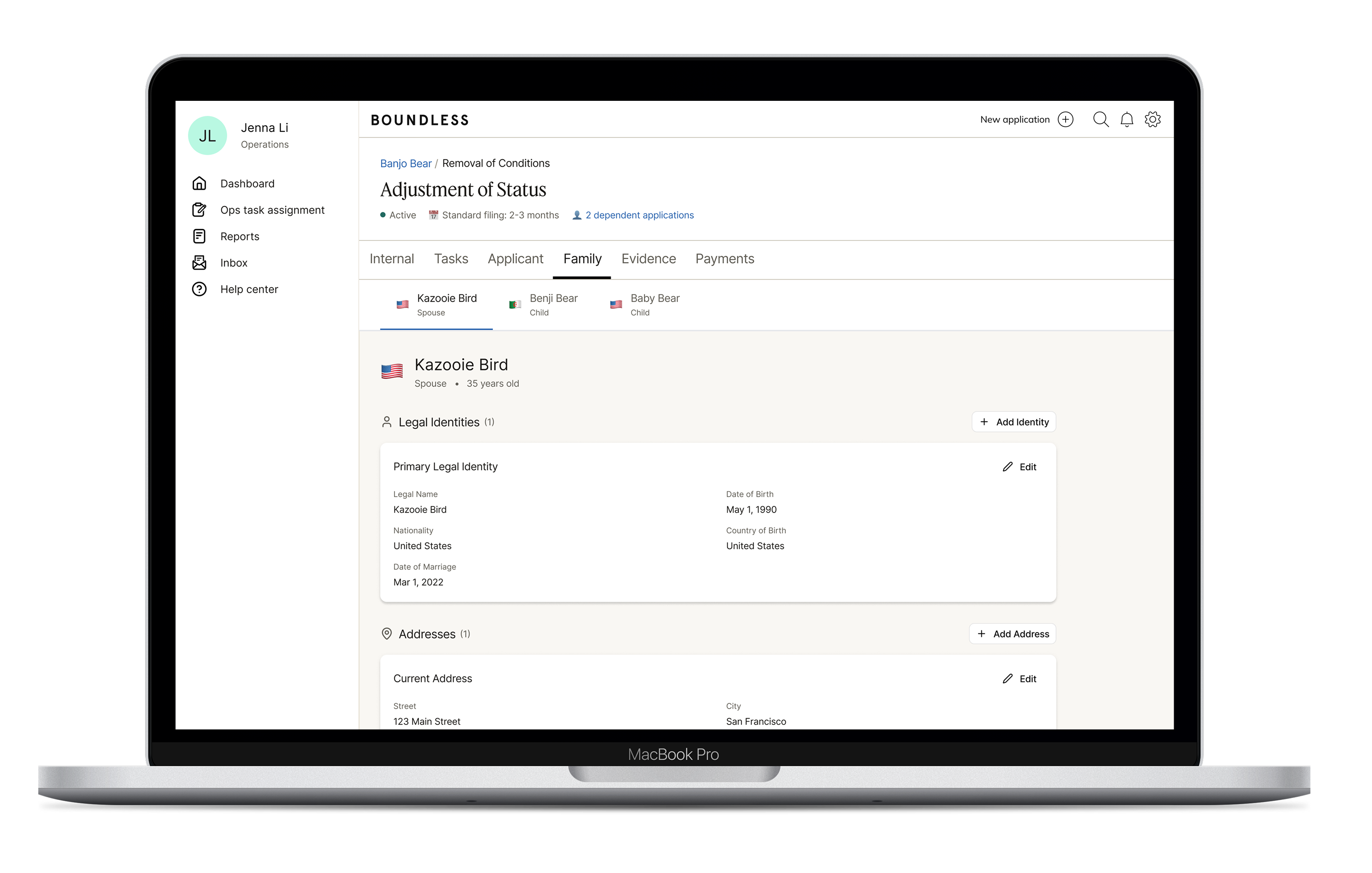
Snapshot of some other concepts that were tested with users - tabbed navigation
Impact & Results
My research findings were presented to the COO and VP leadership, directly influencing a strategic pivot in how Boundless approached operational efficiency.
This insight led to operational restructuring and multi-million dollar cost savings, while also creating a new product opportunity: Joint Services Offering, to fill the gap we identified.
Business Outcomes
- Multi-million dollar cost savings through operational restructuring
- New business line launched: Paralegal-layer product created to address the efficiency gap
- Strategic shift: From "optimize attorney time" to "eliminate systemic waste"
Operational Efficiency
- Attorneys reclaimed ~20% of their day previously spent on administrative tasks
- Review cycles reduced from 5-6 iterations to 2-3
- Case review time reduced from hours to minutes with the Readiness Report
"Research doesn't just inform design—it can reshape business strategy. By quantifying the hidden costs of inefficiency, I gave leadership the data they needed to make difficult but necessary decisions about where to invest resources."
Impact
- The new demo prototypes were extensively used to train ~1000 new teachers during spring and summer training 2023.
- The project managed to save the support needed from ~10 teacher support specialists every year during summer training, which amounted to 300 hours saved during the entire week.
- Ultimately, this solution saved 15 dev-week/year and 200k/year for the organization. This effort was lauded by the leadership, including the director of product and director of design.
IMPACT
- Support Ticket Reduction: Achieved a 30% drop in support tickets for finding resources, validating the direction and enabling educators to focus on teaching.
- Time Efficiency: Redesigned interface that reduced educators' resource search time by 17%, enabling them to invest more time in their core mission.
- Heartfelt Impact: Centered on educators, these positive changes resonated at the heart of the platform, celebrating the real victory in enhancing their daily routines.
REFLECTIONS
- I attended the Summer Training in New Orleans (2022), and saw the real-time implementation of the features, resulting in a significant jump in accessibility. It made me realize the impact of my work, making me proud to be working in education.
- Biggest learning: How to work with the design systems team efficiently to include their feedback early in the project.
- Biggest challenge: Working within tight engineering time and resource constraints to launch this project.
- What I would do differently: I would negotiate for more time and resources on this project, to ensure optimal experience for users.

